


Voya Corporate Pension Intelligence Report 2026

LDI Solutions Strategist

The past year saw record-high funded status across much of the S&P 500 pension universe. But it also revealed something less expected: early signs that some of the most well-funded plans may be moving beyond traditional de-risking.
Executive summary
We are pleased to present the findings of our 2025 year-end Corporate Pension Intelligence Report, where we analyze key trends, characteristics, and performance of the 124 defined benefit plans in the S&P 500 with continuous pension disclosures dating back to December 31, 2007.
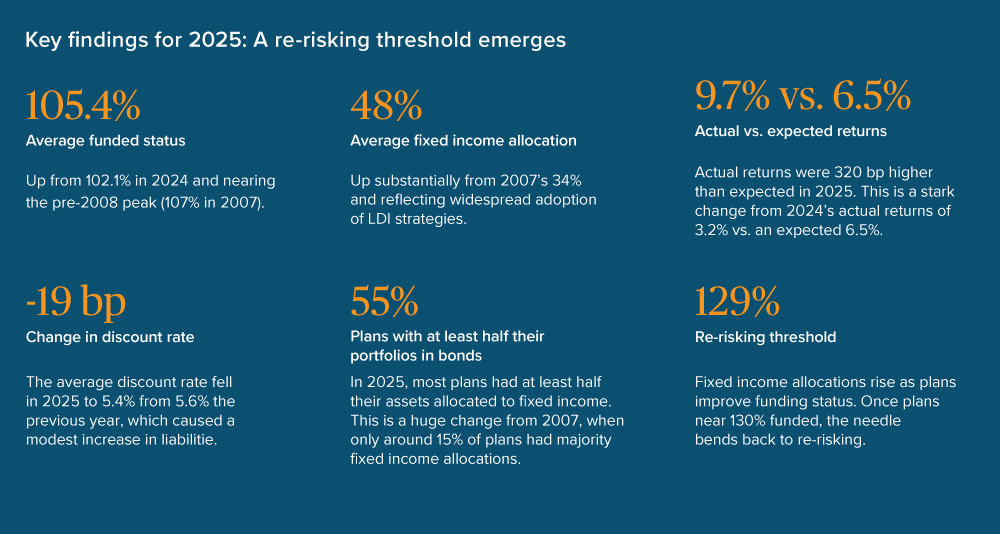
Funded status continued to improve in 2025 and now stands at the strongest levels observed since the global financial crisis (GFC). Most plans’ fixed income allocations also rose to record highs. However, among the most highly funded plans, fixed income allocations appear to have plateaued and are beginning to decline. This makes intuitive sense—as with insurance, the benefits of additional protection begin to diminish once the primary risk has largely been addressed.
One conclusion seems increasingly clear: After two decades of getting back into bonds, the next evolution of LDI may be defined less by how much fixed income a plan owns and more by what resides within that allocation.
We explore this and other developments in the pages that follow.
Methodology
This study examines 124 companies in the S&P 500. Requirements for inclusion:
- Must be an S&P 500 company as of 12/31/2025
- Must have a defined benefit pension plan with assets greater than $100 million
- Must have a fiscal year that concludes on December 31
- Must have continuously disclosed pension data in their annual 10-K filing from 2007 through 2025
Unless stated otherwise, our analysis is in aggregate. For example, total assets and liabilities are the summation of all 124 corporations’ assets and liabilities (as if they represented one big pension plan).
A note about risk: Examples of LDI (liability-driven investing) performance included in this material are for illustrative purposes only. Liability valuations can increase due to falling interest rates or credit spreads, among other things, as the present value of future obligations increases with falling rates and falling spreads. Liabilities can also increase due to actual demographic experience differing from expected future experience assumed by the plan’s actuary. Diversification does not ensure better absolute performance or relative performance versus a pension plan’s liabilities. In addition, investing in alternative investment products such as derivatives can increase the risk and volatility in an investment portfolio. Because investing involves risk to principal, positive results and the achievement of an investor’s goals are not guaranteed. There are no assurances that any investment strategy will be profitable on an absolute basis or relative to the pension plan’s liabilities. Information contained herein should not be construed as comprehensive investment advice. For comprehensive investment advice, please consult a financial professional.