


LDI in Action: Enhancing Yield without Sacrificing the Hedge

LDI Solutions Strategist

Senior Vice President, Head of Client Portfolio Management, Fixed Income

A broader toolkit can be the key to realizing extra yield in the mature, shorter-duration world of modern corporate pension plans.
Executive summary
- The LDI construction calculus is changing: The natural runoff of closed and frozen plans, reinforced by higher rates since 2022, has shortened liability profiles by an average of 3.5 years since 2020.
- For many sponsors, the next step is not just a closer hedge but a better hedge: The goal is to be higher yielding, more diversified, and less dependent on crowded public corporate exposure.
- Investment grade (IG) private credit is the natural complement to corporate bonds: The opportunity is created by distinct borrowers, negotiated terms, and specialized underwriting, along with an attractive customization and complexity premium.
- Commercial mortgage loans, securitized credit, and Treasury derivatives expand the toolkit: Sponsors can add front-end income, different return drivers, and more precise rate hedge implementation.
- Results from real-world plans: The benefits of a more diversified fixed income allocation are not just hypothetical—see how other sponsors have embraced a more modern toolkit.
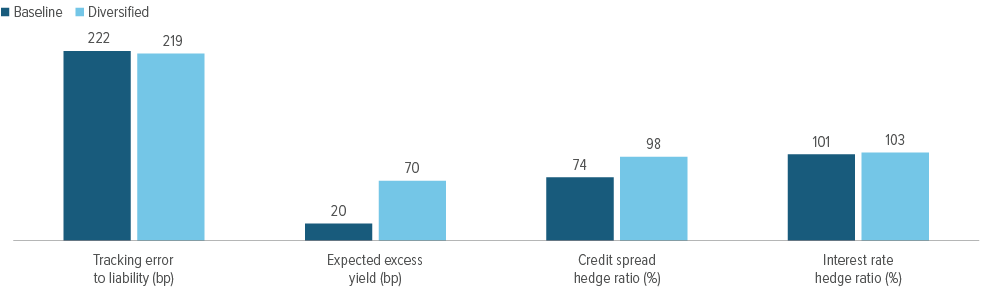
As of 04/30/26. Source: Voya IM. For illustrative purposes only; these are not investable strategies, they are hypothetical case studies based on model portfolios. Past performance does not guarantee future results.
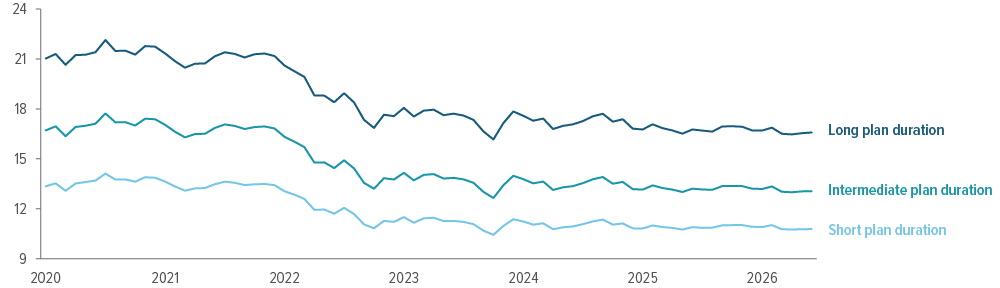
As of 07/10/26. Source: FTSE Pension Discount Curve, Voya IM.
As the problem changes, so should the toolkit
Historically, pension liabilities were long, because plans were open, accruing, and dominated by long-dated benefit obligations. That structure naturally pulled portfolios toward long-duration assets, with public corporates serving as the anchor.
In the last few decades, there has been a significant increase in closed and frozen plans, with at least half of all corporate pension plans commonly assumed to be in “runoff.” As retirees receive benefits and active populations shrink, liability cash flows move forward and duration declines.
The jump in rates in 2022 accelerated this trend, contributing to an average drop of 3.5 years in corporate pension plan duration since 2020 (Exhibit 2). These trends all serve to reduce plans’ need to rely so heavily on long-duration corporates.
In the old regime, insufficient duration was often the main constraint. Today, most plans already have a rate hedge in place and are better funded than they were five years ago, when rates were near zero. The challenge has shifted from simply matching liabilities to building a more efficient hedge. A portfolio may be closely aligned with liabilities while still offering opportunities to improve yield, diversification, liquidity, and spread efficiency (Exhibit 3).
What makes a hedge inefficient? A hedge that earns too little income, holds too many of the same issuers, and depends too heavily on one public market segment is not the strongest version of the hedge. This isn’t as noticeable a problem while markets are buoyant—as they have been for the past several years—but an inefficient hedge’s combination of foregone income and concentration risk can have brutal consequences in down markets.
How can sponsors mitigate this risk? The answer lies in making the best use of plans’ fixed income allocation, and that means using an expanded toolkit.
A note about risk
Please note that liability valuations can increase due to falling interest rates or credit spreads, among other things, as the present value of future obligations increases with falling rates and falling spreads. Liabilities can also increase due to actual demographic experience differing from expected future experience assumed by the plan’s actuary. Please keep in mind that diversification or broad asset allocation, in and of itself, neither ensures nor guarantees better absolute performance or relative performance versus the pension plan’s liabilities. In addition, investing in alternative investment products (e.g., derivatives) can increase the risk and volatility in an investment portfolio. Since investing involves risk to principal, positive results and the achievement of an investor’s goals are not guaranteed.