


In September, Voya IM hosted its exclusive annual gathering of 20+ corporate pension sponsors (with a combined AUM of over $1 trillion) and consultants to discuss shifting allocations and attitudes towards private fixed income. Here’s what they’re saying.
Key takeaways
- While Voya has been managing private assets for visionary sponsors in both defined contribution and defined benefit plans for almost 20 years, the market is reaching a tipping point where investment grade (IG) private assets are now seen as core allocations by the majority of plans.
- Most sponsors adopted IG private credit because of its higher spread, but the asset class’ potential diversification benefits are becoming more of an allocation driver due to concerns over public IG corporate bond market concentration.
- As sponsors grow increasingly comfortable with IG private placements, many are looking to expand their alternative allocation bucket to more strategy types.
- The asset-based finance (ABF) burnout is real, though: Tired of the pitch deck deluge, sponsors are prioritizing stable, long-lived structured asset teams that have established sourcing history and experience with adverse markets.
What are sponsor attitudes towards investment grade private credit in 2026?
With over 90% of asset managers planning to move further into alternative investments over the next three years,1 the debate over private assets has shifted from “if” to “when.”This is reflected in how sponsors are increasingly looking at investment grade private credit as a core part of fixed income portfolios, with allocation levels ranging per sponsor from 10-30%—in line with how life insurers treat the asset class.
For many corporate pension sponsors, private fixed income assets’ ability to slot comfortably into their liability-driven investing (LDI) portfolio is key, which means a strong preference for IG ratings, fixed-rate coupons, and intermediate or higher duration. For public sponsors, who tend toward more of a total return focus, the potential to squeeze an extra 75 100 basis points of yield out of the IG bucket without increasing risk level has been the most compelling argument for the asset class.
While the original motivator for moving into IG private placements may have been, “how can I increase performance of my IG fixed income allocation,” a new driver is fears over the growing concentration of the U.S. IG corporate bond market. Rather than adding a third or fourth manager to chase the same handful of IG corporate bonds, sponsors are initiating or increasing their private placement allocations. The diversification is real—Voya’s general account, for example, has only a 3% issuer overlap between its public IG allocation and its private one.2
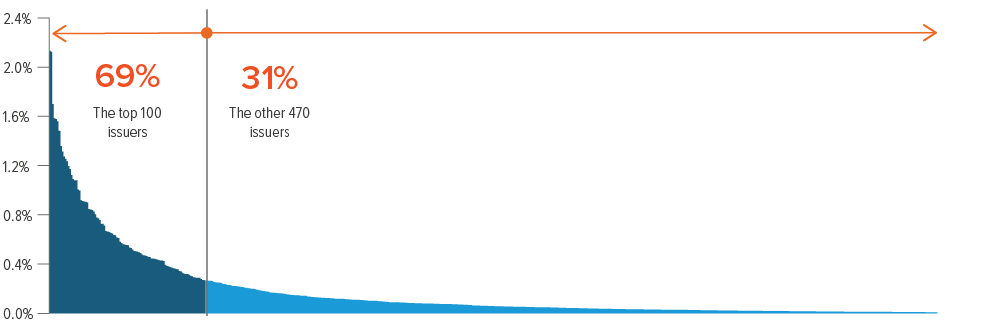
As of 06/30/26. Source: Bloomberg. Chart represents constituents of the Bloomberg Barclays Long U.S. Corporate Index as a percentage of the entire index.
Sponsors also liked IG private placements’ covenants and their potential for non-coupon income, as well as their history of lower losses, but these were seen as secondary to the potential diversification and total return advantages.
Sponsors whose primary experience has been with private equity or below investment grade direct lending funds had a learning curve to understand that in the case of IG private credit, “private” didn’t have to mean “locked up for years until the GP says you can have it back.”
It is possible to make a tactical allocation to IG private placements, and positions can usually be sold within a couple of weeks at full value—which is critical for pensions where plan termination or risk transfer is always a possibility.
Sponsors reported that their trustees were broadly supportive of IG private credit initiatives, with one attendee noting that Voya’s 30-year history in the asset class and its stable, experienced portfolio management team were key factors in gaining trustee approval. The long history of insurer involvement in IG private placements has also helped smooth the path to pension trustee engagement.
How are sponsors approaching integrating private assets into DC plans?
While headlines treat alternative assets in DC plans as a new thing, this is not the case—many DC sponsors have longstanding private asset allocations in stable value and target date funds.
The potential for a sensible allocation to private assets to improve returns does not seem to be in much doubt among attendees, and Voya’s target date models back that up (Exhibit 2). However, sponsors generally agreed that private assets should not be offered as a direct participant choice, favoring professionally managed target date funds and white label solutions that integrate asset allocation and liquidity management.
DB and DC plans have long allocated to traditional core plus strategies. What is changing is the opportunity set: Sponsors are increasingly interested in managers that can extend beyond public fixed income and incorporate non-traditional asset classes, such as IG private placements and commercial mortgage loans (CMLs), within a single, integrated portfolio.
This has resulted in a lot of managers saying they can deliver a finished public/private IG solution. On closer examination, however, it’s usually a traditional core or core plus manager subcontracting with a separate private-markets capability rather than a true, collaborative integration.
This evolution requires in-house capabilities across public and private markets, along with the ability to manage asset allocation and liquidity holistically— potentially offering sponsors broader diversification and more efficient implementation than separate manager allocations.

Source: Voya. Outcomes based on stochastic analysis of 50,000 economic scenarios. This example is for a sample defined contribution target date portfolio with above-average participant earnings and a cash balance plan. Assumptions: Voya 2026 equilibrium capital market expectations. Private market allocations over the life of the plan are illustrated in the glide path, overleaf. Private equity modeled as Buyouts. Private Fixed Income modeled as a blend of direct lending and IG private credit. Starting age of 25 and retirement age of 65. Total annual contributions are 16%. Best-case is represented by the 95th percentile balance and worst case by the 5th percentile balance at retirement age. Monthly post-retirement income is the maximum withdrawal at retirement age that results in a non-zero balance in 90% of the longevity and capital market scenarios. The projections regarding the likelihood of various investment outcomes are hypothetical in nature, do not reflect actual investment results and are not guarantees of future results.
The key distinction is not between “core” and “plus,” or between investment grade and below investment grade; it is whether the manager can dynamically allocate across public bonds, IG private placements, and CMLs.
Only a limited number of firms have the sourcing, underwriting, and portfolio construction capabilities to accomplish this within a genuinely integrated investment process. One of them is Voya—we have been managing multi-sector public/private fixed income mandates in both DC and DB plans for over 20 years.
Sponsors also report disappointing discussions with a lot of new entrants to the space, who may be good alts managers but have no experience in third-party asset management in a retirement context and are unprepared for its operational burdens. “Managers get real excited to meet with us, and then we go through the conversation on ERISA, and their eyes get wider and wider,” one attendee mentioned.
There’s also the frequent issue of the manager needing to walk the custodian through private asset classes, and it’s critical for successful onboarding that the manager has experience having that conversation with the major custodians.
So far, sponsors’ focus for alts in DC is primarily on stable value, target date, and white label options, and their preference is to work with retirement specialist managers who have significant private markets experience. Conversations about pure-play, participant-selected asset vehicles are happening, but sponsors generally concur that these will remain just talk until the Department of Labor provides a lot more guidance.
Where are sponsors most cautious right now?
Sponsors are getting somewhat jaded around asset based finance (ABF) marketing. There is a combined skepticism around certain rating agencies, and a concern that some managers’ big talk (and big fundraises) have not been matched by big origination capabilities, which means sponsors’ allocated funds are sitting idle.
There’s also a concern with some ABF over what clients ultimately own; some deals can feel more nebulous and require a lot of due diligence.
ABF is still appealing to sponsors, but by and large, they are looking for 95% IG at purchase or origination. For DB sponsors running LDI portfolios, they’re also looking for pure fixed-rate exposure.
And then within that smaller universe of high-quality, fixed-rate ABF, they’re looking for proven, diverse production abilities.
Given all this, there’s a definite sponsor preference for ABF teams that have been in the IG space for decades and understand what can go wrong and where these structures break. A strong workout process is also an important factor. Ultimately, sponsors seem to be landing on ABF mandates with a couple of managers—a specialist with direct origination, and a generalist who can get them access to the universe of deals beyond the specialist’s reach.
“Managers get real excited to meet with us, and then we go through the conversation on ERISA, and their eyes get wider and wider.” |
What sponsors are generally not looking for is managers offering ABF that’s nothing but consumer assets or resi mortgage, or deals that are called investment grade only because the manager has dumped leverage on below investment grade assets.
They’re also very cautious around ABF vehicles’ liquidity provisions, given that the asset class’ lower liquidity profile can become an issue with plan termination or risk transfer. However, for DB sponsors with a more aggressive total return target, there is a place for less liquid intermediate-duration ABF— as long as the allocation is sized appropriately.
Ironically, despite BDCs’ and evergreen funds’ rough year with retail investors, sponsors do not seem to be feeling nearly as cautious about middle market private credit. This reflects in part institutional investors’ deeper experience with both the asset class and less liquid investments in general.
It helps that institutional senior loan funds tend to be larger and better established than their retail equivalents. Institutional investors also have access to a larger opportunity set with more diversified options in the below IG private credit space than retail investors.
For example, the growing private credit secondary fund market allows access to portfolios of seasoned loans obtained at attractive discounts, with greater diversification across vintage years and managers.
Institutions also have access to compelling specialist lending funds, such as direct infrastructure credit— which benefits from consistently high demand for energy infrastructure and projects with attractive long-term offtake contracts with investment grade counterparties
. And, bluntly, secondary funds and specialist infrastructure funds still have the potential to provide unleveraged net IRRs comfortably over 10% per year, with a history of minimal credit losses. With manager dispersion already on the rise across below IG private credit, sponsors can benefit from moving beyond the beta-heavy mega-funds to proven specialist strategies.
What do sponsors see as the next step after investment grade private credit?
IG private placements are often sponsors’ first step into private and alternative fixed income: It’s got reasonable liquidity; there’s a clear history of successful adoption in pension and insurance portfolios; and it has well-established potential diversification and spread benefits while remaining in an IG risk profile.
The early DC adopters that have worked with Voya for a decade or more have often broadened their allocations following the successful integration of IG private placements, through increased allocations to ABF and infrastructure and incorporating new allocations to IG commercial mortgage loans (CMLs), and Voya’s mortgage derivatives strategy.
Each step increases potential diversification and lowers correlation to the corporate credit cycle, which can enhance total return. Mortgage derivatives especially are highly liquid and have low correlation to standard residential mortgage-backed securities, while infrastructure offers historically low sensitivity to both corporate and economic volatility.
The timing and amount of these steps for DB pensions depends, of course, on plan benchmarks, risk tolerance, liquidity needs, and duration targets. Some different plans’ approaches can be seen in Exhibit 3.
For DC plans, implementation tends to begin with carefully targeted CIT exposure within stable value or a single-manager white label core plus fixed income solution, with some sponsors ultimately considering a multi-manager target date option.
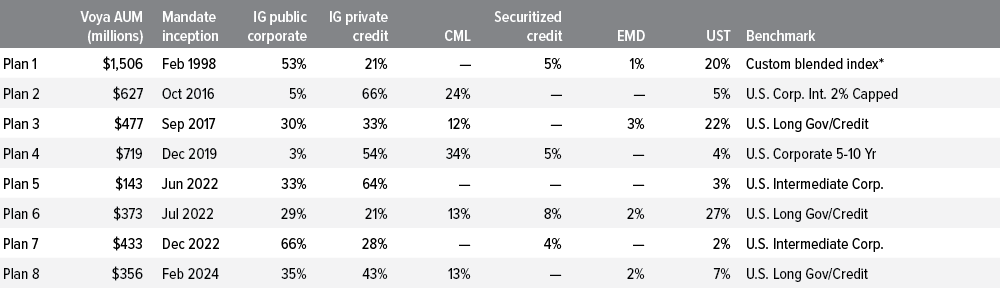
As of 06/30/26. Source: Voya IM. *Portfolio has transitioned three times since 1998. Custom blended liability-based benchmark began in 2023. Prior to that, the index was composed of a custom blend of long U.S. Treasuries and long U.S. corporate. Table shows asset allocation of individual client pension plans; these are not investable strategies. For illustrative purposes only. Past performance does not guarantee future results.
What’s next?Voya is a company built on retirement, with $1.2 trillion under management and administration and 65,000 plans trusting us to help provide better retirement outcomes for more than 18 million participants and beneficiaries.3 Retirement isn’t just a product for us. It’s who we are. We are also one of the pioneers of public and private multi-sector fixed income, with an unbroken production history stretching back to 1990—and legendary client service. We would love the opportunity to discuss how we can help you achieve your plan’s goals. |
A note about risk
All investing involves risks of fluctuating prices and uncertainties of rates of return and yield. All security transactions involve substantial risk of loss. High-Yield Securities, or “junk bonds”, are rated lower than investment-grade bonds because there is a greater possibility that the issuer may be unable to make interest and principal payments on those securities. The strategy may use Derivatives, such as options and futures, which can be illiquid, may disproportionately increase losses and have a potentially large impact on performance. Foreign Investing does pose special risks including currency fluctuation, economic and political risks not found in investments that are solely domestic. Risks of foreign investing are generally intensified in Emerging Markets. As Interest Rates rise, bond prices may fall, reducing the value of the share price. Debt Securities with longer durations tend to be more sensitive to interest rate changes. Other risks of the Fund include but are not limited to: Credit Risks; Other Investment Companies’ Risks; Price Volatility Risks; Inability to Sell Securities Risks; and Securities Lending Risks.