


Short Duration High Yield: Income Without the Rate Call

Senior Vice President, Lead Portfolio Manager - Income & Growth

Senior Vice President, Lead Portfolio Manager - Income & Growth

Short duration high yield bonds showed their defensive value as Treasury yields surged in the third quarter. But the investment case isn’t reliant upon on where rates go next.
Key takeaways
- Short duration high yield (SDHY) bonds limited the damage of rising Treasury yields in 3Q, declining just 1.21% versus a 3.51% loss for the U.S. Agg.
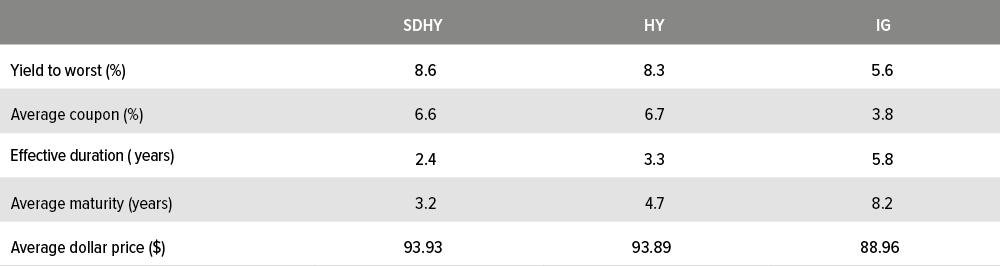
- Entering 4Q, SDHY offers an 8.6% yield to worst with just 2.4 years of duration— a better tradeoff than either broad high yield or investment grade bonds.
- Data since 2009 shows SDHY has captured most of broad high yield’s return with less volatility and strong risk-adjusted returns across market cycles.
A complement to your core
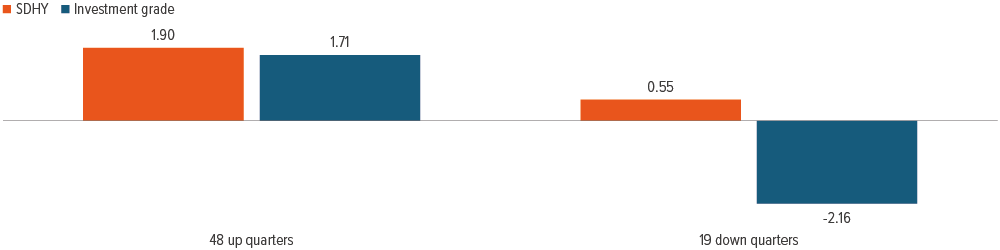
The sharp rise in Treasury yields in the third quarter was a timely reminder of the diversification benefits short duration high yield (SDHY) bonds can bring to a core fixed income allocation. SDHY declined just 1.21%, compared with a 3.51% loss for the U.S. Agg. But its complementary role isn’t limited to periods of rising rates: historically, SDHY has helped cushion negative core bond returns while retaining meaningful participation when broader fixed income markets rally.
As of 09/30/26. Source: Bloomberg, Voya IM. See below for index definitions.
SDHY has delivered positive returns in both up and down rate environments.
Reducing rate dependency
The prospect of further rate volatility means investors must plan for a variety of different scenarios. Adding SDHY to a core allocation offers an efficient way to achieve this: If yields rise, SDHY’s lower rate sensitivity can help limit price pressure. If yields fall, its income and credit exposure can continue to support total returns.
As of 09/30/26. Source: Bloomberg, Voya IM. See below for index definitions.
SDHY offers more yield than broad high yield (HY) or investment grade (IG) bonds, with the shortest duration of the three markets.
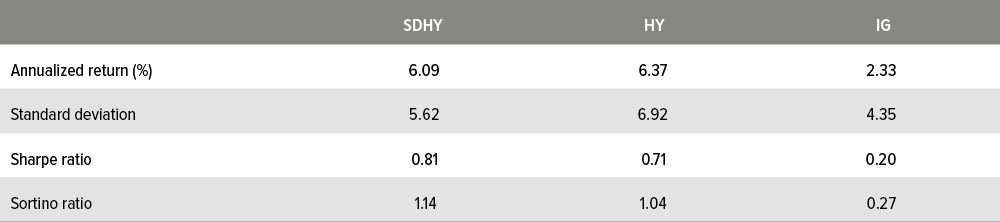
Since 2009, SDHY has captured nearly all of broad high yield’s return with less volatility, while meaningfully outperforming investment grade bonds. As a result, it has produced the strongest risk-adjusted returns of the three markets, as measured by both Sharpe and Sortino ratios. That favorable tradeoff has historically translated into strong long-term results.
As of 09/30/26. Source: Bloomberg, Voya IM. See below for index definitions.
SDHY delivered more return per unit of risk than either broad high yield or investment grade bonds.
Outlook: Income without a large duration bet
We see the current setup as constructive for SDHY. Current yield to worst of 8.6% provides an attractive starting point for returns. An effective duration of 2.4 years limits exposure to further Treasury-market volatility. And default risk appears contained by solid issuer fundamentals and limited near-term refinancing needs, although tight spreads underscore the importance of disciplined security selection.
For institutional investors, SDHY bonds can serve as a strategic complement to core fixed income—adding income, reducing portfolio-level rate sensitivity, and improving the potential for risk-adjusted returns across market cycles.
A note about risk: Debt instruments: Debt instruments are subject to greater levels of credit and liquidity risk, may be speculative, and may decline in value due to changes in interest rates or an issuer’s or counterparty’s deterioration or default. High yield fixed income securities: There is a greater risk of issuer default, less liquidity, and increased price volatility related to high yield securities than investment grade securities. Market volatility: The value of the securities in the portfolio may go up or down in response to the prospects of individual companies and/or general economic conditions. Price changes may be short or long term. Local, regional or global events such as war, acts of terrorism, the spread of infectious illness or other public health issues, recessions, or other events could have a significant impact on the portfolio and its investments, including hampering the ability of the portfolio’s manager(s) to invest the portfolio’s assets as intended. Issuer risk: The portfolio will be affected by factors specific to the issuers of securities and other instruments in which the portfolio invests, including actual or perceived changes in the financial condition or business prospects of such issuers. Interest rate risk: The values of debt instruments may rise or fall in response to changes in interest rates, and this risk may be enhanced for securities with longer maturities. Credit risk: If the issuer of a debt instrument fails to pay interest or principal in a timely manner, or negative perceptions exist in the market of the issuer’s ability to make such payments, the price of the security may decline.