


Risk Perspectives in Small Cap Growth: When Underexposure Becomes a Risk
Abstract art

Success in small caps increasingly depends on position sizing, as concentrated winners amplify the cost of underexposure.

Bigger positions, bigger consequences

When considering risks in portfolios, managers often focus on mitigating “downside risk”—the risk of losing money. But managers must also consider “upside risk”— having little or no exposure to stocks of fast-growing companies that achieve meaningful benchmark weights. 

Faster information flow, intense investor attention, and momentum around transformational technologies such as artificial intelligence (AI) can quickly push a stock from a modest index weight to a major driver of returns. For an active manager, position sizing decisions can have an increasingly meaningful effect on portfolio outcomes— especially as small cap indexes have become more concentrated (see chart).
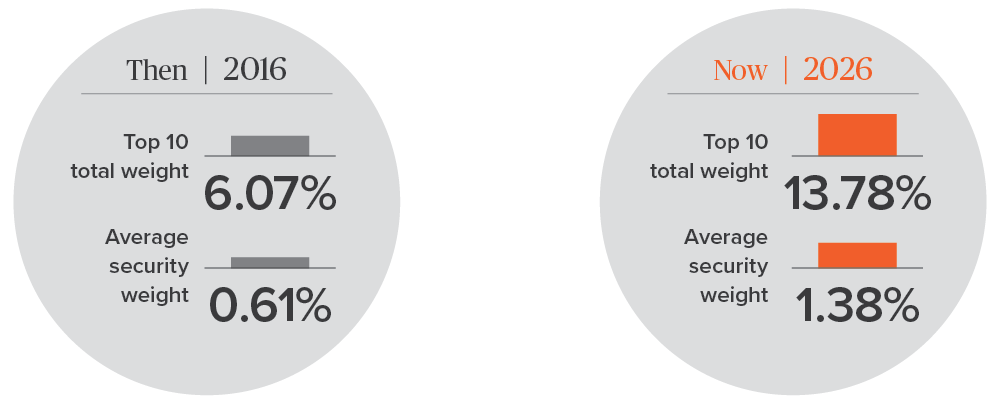
Russell 2000 Growth Index
10 largest positions in Russell 2000 Growth
Russell 2000 Growth Index

As of 06/25/26. Source: FactSet.

As benchmark weights rise, so does relative risk

Excluding larger benchmark constituents on valuation grounds alone can increase the risk of meaningful underperformance. For example, in the momentum-driven market of 2025, the average small cap growth manager underperformed the Russell 2000 Growth Index by 5.22%.

The culprit? Many of the strongest performers that year initially screened as expensive, but they appreciated rapidly through a combination of AI exposure and accelerating revenue and earnings growth. 

The importance of position sizing decisions extends beyond a single market cycle. Small caps have historically generated higher earnings growth than large caps over long periods of time, yet they currently trade at a substantial valuation discount. Missing participation in the companies driving that growth can therefore carry meaningful opportunity cost for investors.

Case study: Bloom Energy (BE)

In mid-2025, Bloom Energy’s fundamentals were improving rapidly due to the company’s emergence as a mission-critical power infrastructure partner for AI hyperscalers, and we believed its growing benchmark weight warranted attention.

However, at first glance, its valuation did not fully fit our traditional growth-at-a-reasonable-price discipline. Rather than ignore the opportunity, we scrutinized the fundamentals, formed a favorable opinion of the revenue growth prospects for the company, and realized valuation was not as stretched as the initial screen would have indicated.

 Therefore, we established a slightly overweight position that provided exposure to the opportunity in line with our level of conviction. This was an active decision grounded in research, not a reaction to price momentum alone.

Small caps demand a more dynamic approach to position sizing

We believe small cap growth remains an attractive option for three reasons: 

  1. Opportunities to broaden diversification and reduce concentration risk 
  2. Strong earnings potential at discounted valuations relative to large caps 
  3. Benefits when company-specific or market catalysts improve

To capture increasingly dynamic opportunities in small caps, we believe managers can’t assume that yesterday’s position sizing conventions will remain sufficient as benchmark weights change more rapidly. Fully capturing the long-term opportunity in small caps increasingly depends on the ability to assess both upside and downside risk and adjust position sizes accordingly.

5974878

The principal risks are generally those attributable to investing in stocks and related derivative instruments. Holdings are subject to market, issuer, and other risks, and their values may fluctuate. Market risk is the risk that securities or other instruments may decline in value due to factors affecting the securities markets or particular industries. Issuer risk is the risk that the value of a security or instrument may decline for reasons specific to the issuer, such as changes in its financial condition. More particularly, the strategy invests in smaller companies, which may be more susceptible to price swings than larger companies because they have fewer resources and more limited products, and many are dependent on a few key managers. Index returns do not reflect fees, brokerage commissions, taxes, or other expenses of investing. Investors cannot invest directly in an index. Effective January 1, 2022, Voya Investment Management acquired the investment advisory business and certain other assets of Tygh Capital Management (TCM). As such, AUM, performance, and characteristics prior to 12/31/21 pre-date the acquisition and are reflective of the strategy as managed by TCM. Please see attached GIPS Compliance Schedule of Composite Performance. The strategy employs a quantitative model to execute the strategy. Data imprecision, software or other technology malfunctions, programming inaccuracies, and similar circumstances may impair the performance of these systems, which may negatively affect performance. Furthermore, there can be no assurance that the quantitative models used in managing the strategy will perform as anticipated or enable the strategy to achieve its objective. 

The Russell 2000 Growth Index is an unmanaged index that measures the performance of smaller U.S. companies with greater-than-average growth orientation. It is a small cap stock market index that comprises the smallest 2,000 stocks in the Russell 3000 Index. The Fund discussed may be available to you as part of your employer-sponsored retirement plan. There may be additional plan-level fees, which could cause personal performance to vary from stated performance. Please call your benefits office for more information. This commentary has been prepared by Voya Investment Management for informational purposes. Nothing contained herein should be construed as (i) an offer to sell or solicitation of an offer to buy any security or (ii) a recommendation as to the advisability of investing in, purchasing, or selling any security. Any opinions expressed herein reflect our judgment and are subject to change. Certain of the statements contained herein are statements of future expectations and other forward-looking statements that are based on management’s current views and assumptions and involve known and unknown risks and uncertainties that could cause actual results, performance, or events to differ materially from those expressed or implied in such statements. Actual results, performance, or events may differ materially from those in such statements due to, without limitation, (1) general economic conditions, (2) performance of financial markets, (3) interest rate levels, (4) increasing levels of loan defaults, (5) changes in laws and regulations, and (6) changes in the policies of governments and/or regulatory authorities. The opinions, views, and information expressed in this commentary regarding holdings are subject to change without notice. The information provided regarding holdings is not a recommendation to buy or sell any security. Portfolio holdings are fluid and are subject to daily change based on market conditions and other factors. Past performance does not guarantee future results.

Top