


Why RMBS Could Feel Housing Policy Before Housing Does

Head of Securitized

SVP, Head of Responsible Investment and Thematic Research

VP, Sustainability Research Analyst

New housing policies may not reset home prices quickly, but they could reshape the mechanics that drive mortgage lending, RMBS spreads, cash flows, and relative value.
Key takeaways
Whereas housing policy strategy is focused on affordability, the more direct near-term investment story is about the mechanics that sit between borrowers, lenders, banks, and bond investors, which can adjust much faster than housing stock.
For securitized credit, the key questions are how soon and to what degree executive orders and regulatory capital changes can lower origination friction, expand bank balance sheet capacity, influence refinancing incentives, and support a deeper market for mortgage risk.
If those channels work, the result could be a yet more actionable opportunity set for residential mortgage-backed securities (RMBS) better liquidity, faster transaction de-leveraging, more issuance, and greater dispersion across coupons, collateral types, geographies, originators, and structures.
That dispersion may create room for relative-value selection, but it also puts more importance on quantifying risks such as prepayment behavior, collateral quality, and macro sensitivity with greater precision—all dimensions for alpha production.
Policy urgency builds to address affordability
In the past few years, housing affordability has evolved from a periodic, cyclical concern to an enduring structural force and now a political pressure point. Rents have skyrocketed and homeownership has become increasingly out of reach at a time when other living expenses such as food, fuel, insurance, and student loan repayments are also reducing a household’s bottom line. These growing pressures on consumers have made the cost of living a key voter issue in 2026, creating a rare moment of bipartisan alignment on the affordability crisis.
As a result, Washington has rarely been this busy on housing. This year alone, three major housing-related executive orders (EOs) have been enacted, the 21st Century ROAD to Housing Act became law, and federal agencies are set to announce a final ruling on bank capital requirements. While these are positive developments, supply-focused policies won’t solve the affordability crisis overnight. Years of underbuilding, low vacancy rates, and a higher-for-longer rate environment suggest that the supply/demand imbalance could take years to resolve.
Fortunately, investors could see policy benefits long before the effects show up in housing data. The question is how and when policies may help to unclog the plumbing of mortgage markets, affecting factors such as origination costs, bank lender participation, mortgage-backed security (MBS) spread dispersion, refinancing activity, and prepayment speeds.
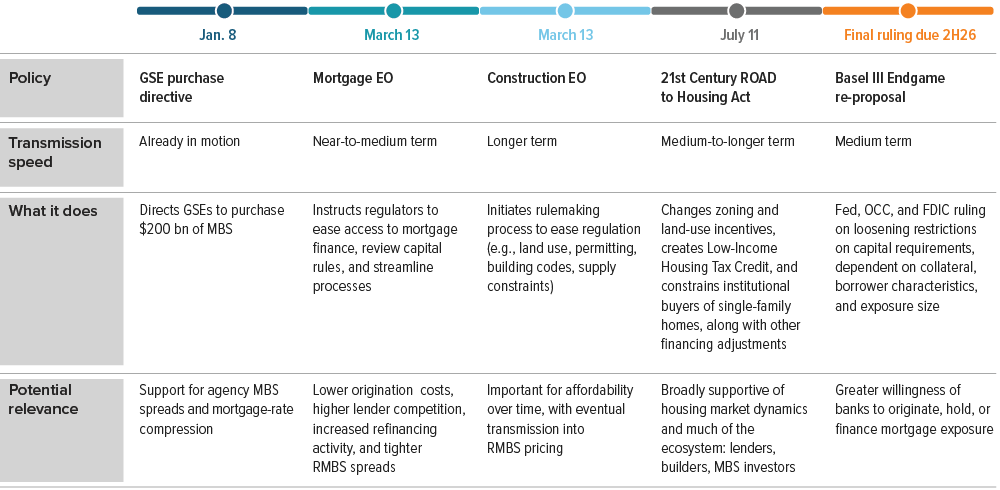
Source: Federal Housing Finance Agency; Executive Order 14393, “Promoting Access to Mortgage Credit”; Executive Order 14394, “Removing Regulatory Barriers to Affordable Home Construction”; H.R. 6644, 21st Century ROAD to Housing Act; Federal Reserve; Voya IM analysis as of 07/31/26.
A note about risk: The principal risks are generally those attributable to bond investing. Holdings are subject to market, issuer, credit, prepayment, extension, and other risks, and their values may fluctuate. Market risk is the risk that securities may decline in value due to factors affecting the securities markets or particular industries. Issuer risk is the risk that the value of a security may decline for reasons specific to the issuer, such as changes in its financial condition. The strategy invests in mortgage-related securities, which can be paid off early if the borrowers on the underlying mortgages pay off their mortgages sooner than scheduled. If interest rates are falling, the strategy will be forced to reinvest this money at lower yields. Conversely, if interest rates are rising, the expected principal payments will slow, thereby locking in the coupon rate at below-market levels and extending the security’s life and duration while reducing its market value.