


Investment Grade Private Credit: Real Estate Finance

Senior Vice President, Head of Corporates

Lending to real estate investment trusts and similar vehicles allows credit portfolios to achieve diversified commercial real estate exposure at an attractive premium to public debt, and with significant structural risk mitigation.
Key takeaways
- Investment grade (IG) private credit offers investors an excellent way to add portfolio exposure to the vast universe of commercial real estate.
- Real estate investment trusts (REITs) finance asset purchases largely through balance sheet finance (borrowing at the portfolio level) rather than mortgages (borrowing at the individual property level), and are reliable repeat borrowers.
- Via REIT balance sheet finance, investment grade credit investors can gain access to diversified (and often massive) portfolios of income-producing properties at conservative loan-to-value ratios and attractive spreads.
- Because of their covenant guardrails and high level of asset diversification, these placements have historically performed well during periods in which other forms of commercial real estate credit have struggled.
- Three case studies demonstrate Voya’s capabilities as one of the largest and most experienced investors in investment grade REIT private placements.
Commercial real estate runs on debt
Commercial real estate is a massive asset class—estimated to be $30 trillion in the U.S. alone, representing a broad and deep pool of investment opportunity for both credit and equity investors (Exhibit 1). REITs, both public and private, hold a substantial position in the CRE space, maintaining large portfolios of investment property.1
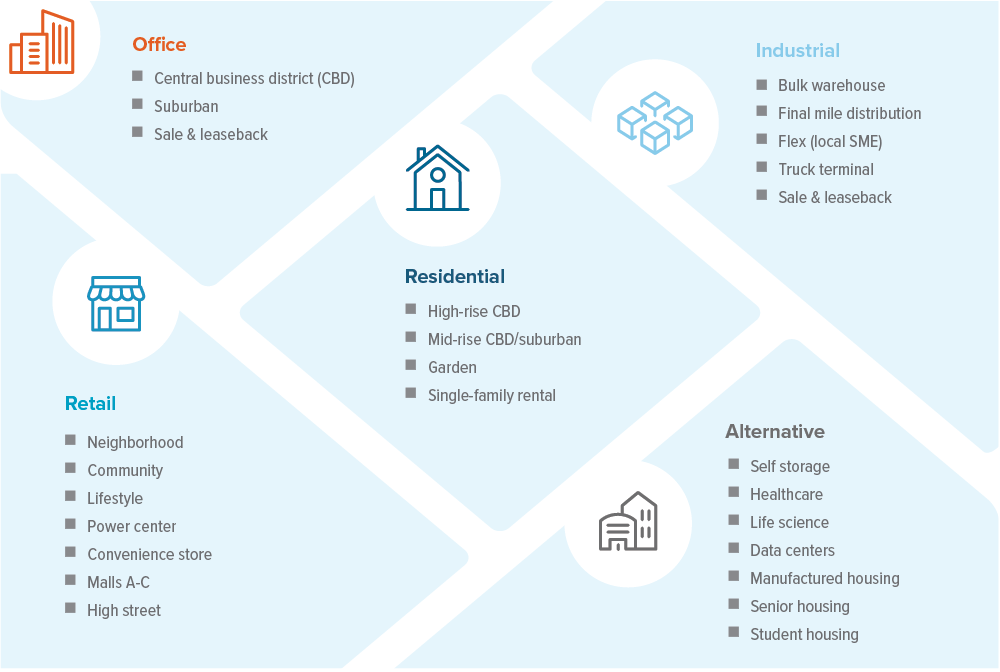
As of 07/05/26. Source: Voya IM.
The long-term, income-producing nature of REITs’ hard asset portfolios is an excellent match for the long-term, fixed-rate, scalable capital that is available to them in both public and private bond markets. Appropriate debt capital allows REITs to invest in new properties via acquisition or development and to leverage their equity returns. Debt capital forms a large and enduring component of capital structures within the space.
As an example, the U.S. public investment grade bond market includes around 100 REIT issuers, with outstanding bonds of approximately $300 billion in aggregate. In 2025, the sector accounted for $48 billion of public debt issuance, and ratings generally ranged from A to BBB-.2
The REIT sector has the distinction in the public corporate bond market of being the only sector where bond deals routinely contain a suite of standard financial covenants in favor of bondholders: limits on total leverage, secured leverage, interest coverage, and unsecured asset cover. Many analysts credit the sector’s near-zero default history, at least in part, to these protections.
Why private markets?
While the public market for REIT bonds is well established, many REITs prefer to borrow in the private market instead, for various reasons discussed below. Over the past 10 years, about 25% of REIT debt issuance by volume has gone to the private market (Exhibit 2).
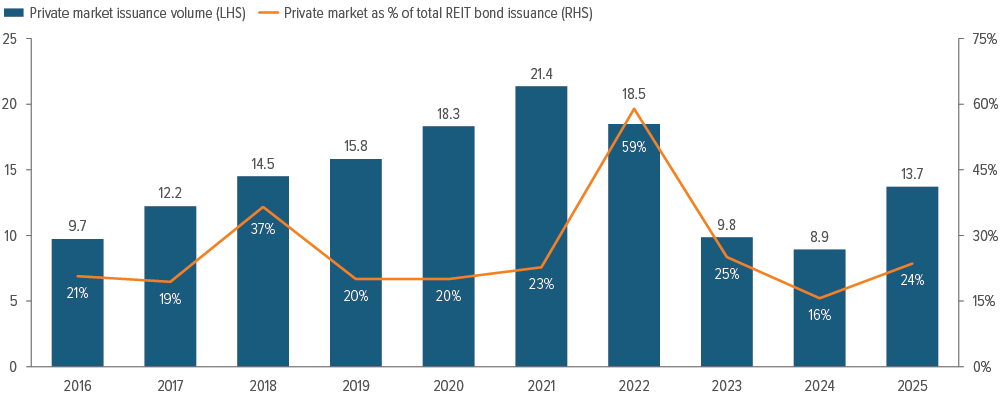
As of 06/01/26. Source: Voya IM, Nareit, BofA Global Research.
REITs became sizeable issuers in the investment grade private credit market in the early 2010s, due to the market’s excellent fit with their business model. Like the public market, the private market is a reliable source of long-term, fixed-rate, scalable capital—but it also offers additional benefits to issuers:
- Extensive customization of sizes and tenors
- Deep underwriting engagement and ongoing creditor relationships
- The ability to issue notes that are rated by fewer agencies than the public market requires
- Openness to privately held issuers that want to keep their financial disclosures within a smaller group and avoid registering with the SEC
While the public bond market requires bond issues of at least $500 million to be well received and eligible for inclusion in indexes, the private market is open to smaller tranches and smaller transactions. Private deals range from $100 million to over $1 billion, with sizing completely at the issuer’s pleasure. Some issuers have a few hundred million outstanding in the market, while many repeat issuers have much more, including one REIT with over $7 billion of private notes outstanding.
Non-U.S. issuers also value the ability to tap deep institutional pockets in the U.S. without the formality of a registered bond deal. Private issuance from IG REITs comes primarily from the U.S., but there is also significant U.S. dollar issuance from the U.K., Western Europe, and Australia, where issuer profiles are highly similar but bond markets are not as deep. Here, U.S. investors are able to gain valuable diversification in high-quality portfolios not otherwise accessible in our domestic public markets.
For private credit investors, the benefits of private market REIT debt include important additional covenant protections, the opportunity for deep diligence and an ongoing dialogue with the borrower, and attractive spread premiums over equivalently rated public REIT debt (Exhibit 3).
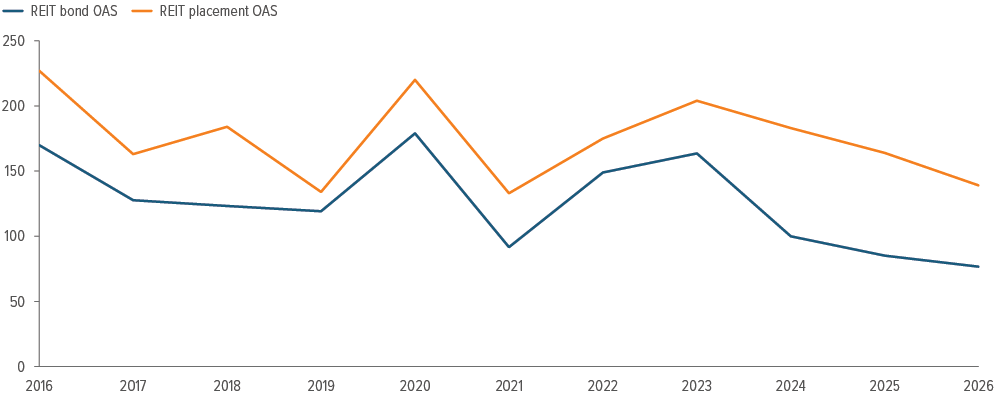
As of 06/15/26. Source: Bloomberg, Voya IM.
A note about risk
All investing involves risks of fluctuating prices and uncertainties of rates of return and yield. All security transactions involve substantial risk of loss.
Private credit: Foreign investing does pose special risks, including currency fluctuation, economic, and political risks not found in investments that are solely domestic. As interest rates rise, bond prices may fall, reducing the value of the share price. Debt securities with longer durations tend to be more sensitive to interest rate changes. High yield securities, or “junk bonds,” are rated lower than investment grade bonds because there is a greater possibility that the issuer may be unable to make interest and principal payments on those securities. Other risks of private credit include, but are not limited to: credit risks, other investment companies risks, price volatility risks, inability to sell securities risks, and securities lending risks.