


CIO Commentary: What Happens When Nobody Refinances?

Chief Investment Officer, Fixed Income

Earlier this week, the 30-year U.S. mortgage rate touched 7.5%, exceeding the roughly 7.1% yield on BB bonds. If you go back 20 or 30 years, investors typically required 180 to 375 basis points more to lend unsecured to speculative-grade companies rather than to a homebuyer with her 20% equity subordinate to your mortgage. These things have converged, and that has a couple interesting macro and market implications. The first is a relative value trade—and here’s why prepayment might not matter as much as you think.
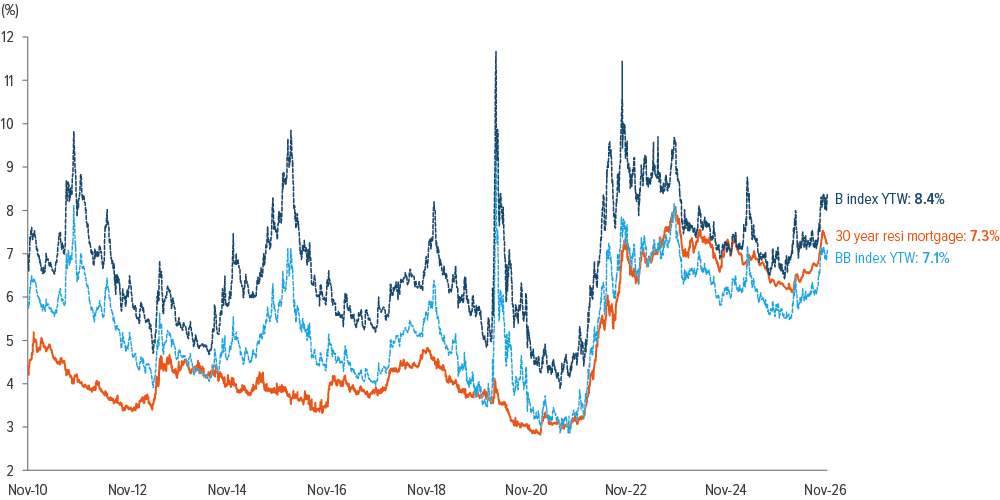
As of 11/17/26. Source: Bloomberg. BB bonds represented by the Bloomberg Ba High Yield Index yield to worst; B bonds represented by the Bloomberg B High Yield Index yield to worst.
Let’s be honest: nobody wants 7.5% mortgages sticking around, especially the people paying them. Sooner or later, rates will drop, prompting homeowners to refinance and taking that attractive yield with them. But most high yield bonds are prepayable too—they have a short- dated call option. Those calls can be hard to predict and can happen for a lot of reasons.
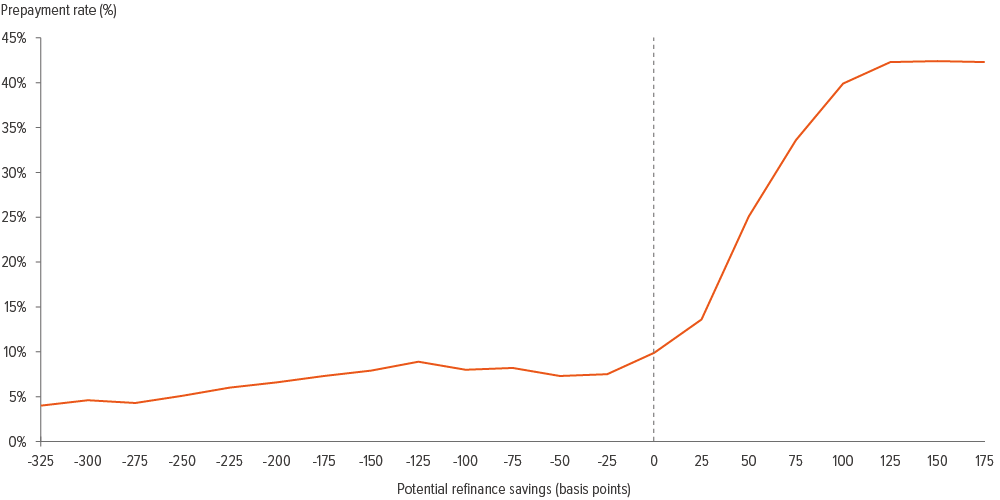
As of 11/15/26. Source: Freddie Mac, CPR/CDR, Voya IM. Data from 2021-2022
Mortgage prepayment, on the other hand, is really well understood. Prepayments stay low and slow until the current mortgage rate drops 50 basis points below what borrowers are already paying. Then people start refinancing. Right now, 73% of outstanding mortgage principal has a coupon of 6% or below. What that means is rates have to fall at least 50 basis points to make those 7.5% mortgages begin to go away, and over 200 basis points to make 6% mortgage prepayments budge.
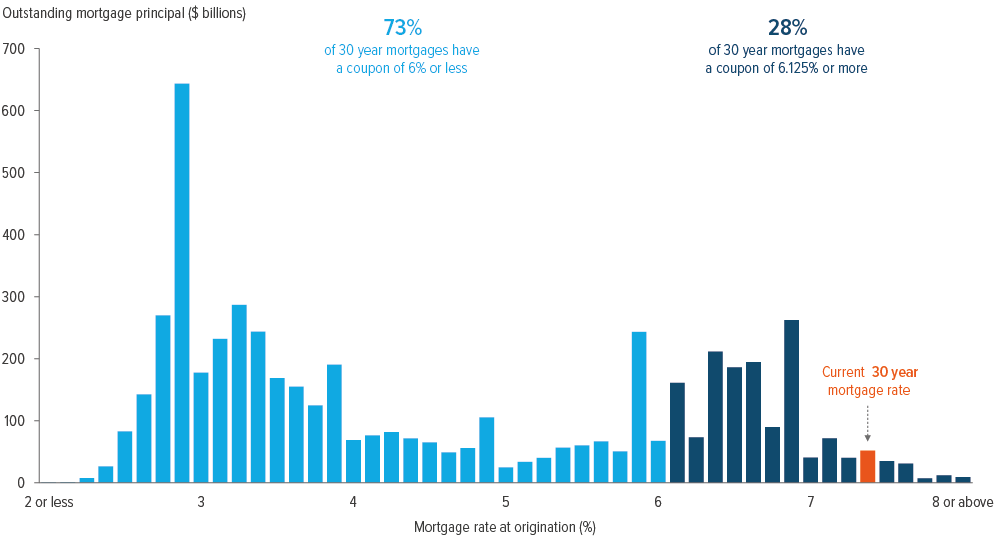
As of 11/17/26. Source: CPR/CDR, Voya IM.
How do you play that as an institutional investor? Resi whole loan is an obvious route, with non- qualifying mortgages offering potentially 50 basis points of extra spread on borrowers with historically high credit quality. Mortgage derivatives are also attractive, since spread premium has stayed elevated but collateral risk has gone down. Even good old 6% agency mortgage pass-throughs are at pretty decent discounts right now.
The macroeconomic consideration overhanging all of this is that there have been periods when housing has been a much more meaningful contributor to GDP growth. Today, it just isn’t: Residential fixed investment as a percent of GDP has been flat or shrunk the last seven out of ten years, and existing home sales just hit their lowest level since August 2010.1
For once, these doldrums are not a bad thing. The interest rate-sensitive parts of the economy —many of which are at the top of their cycles—are already under pressure, which Fed tightening would make worse. Housing, on the other hand, is likely to experience much more muted effects, even as it potentially pays you more than some high yield bonds.
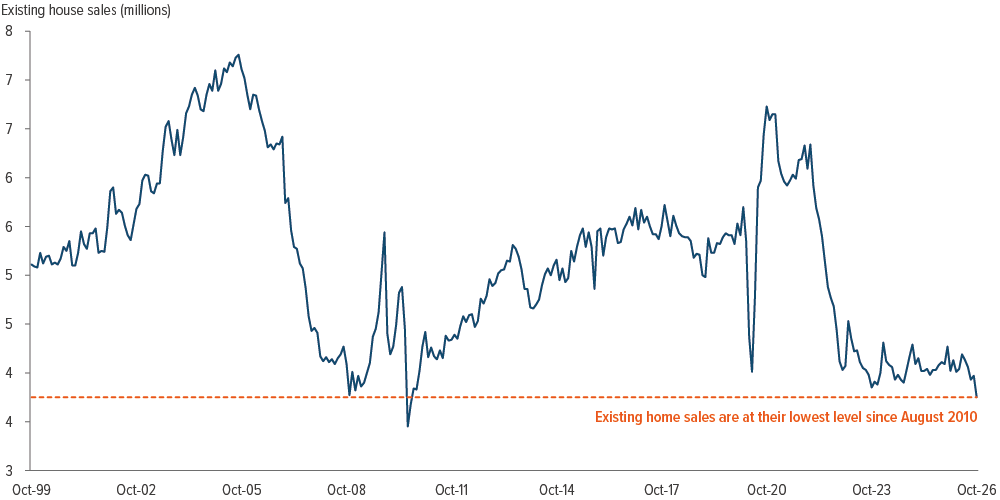
As of 11/17/26. Source: National Association of Realtors.