
Beyond Traditional Metrics: Excess Capital Yield’s More Complete Measure of Value
Treasury Yield

A low valuation can identify an inexpensive stock, but it doesn’t necessarily signal a company’s ability to create value over time.

Good value is more than a low price

A stock can look inexpensive for many reasons, depending on which aspect of its financial profile you consider. Traditional valuation metrics focus on different things, which can lead to very different conclusions about value.
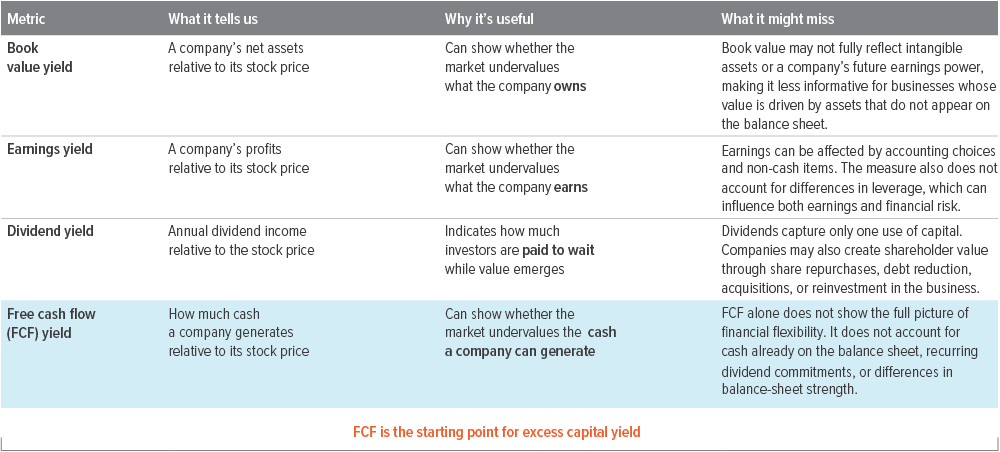
Traditional valuation metrics offer different views of value

Of these traditional measures, we believe free cash flow yield provides the strongest foundation for assessing a company’s capacity to create additional shareholder value. But FCF alone does not capture the full extent of a company’s financial flexibility. That’s where excess capital yield comes in.

Excess capital yield: A more complete measure of value

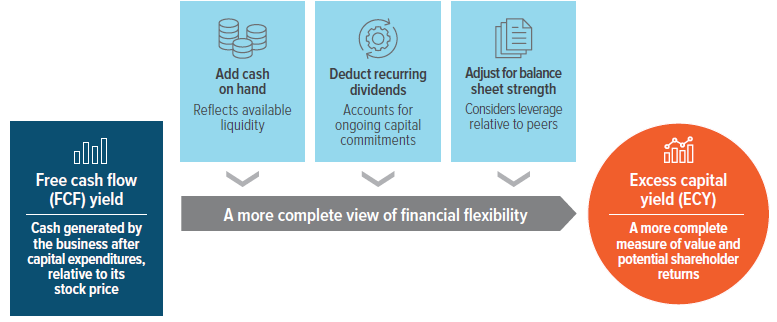
Excess capital yield (ECY) builds on the foundation of FCF by adjusting the metric to capture additional sources of financial flexibility and value creation.
1

Importantly, this calculation combines data from all three financial statements and reduces reliance on potentially distorted earnings measures. The result is a clearer view of the “dry powder” available to a company to supplement value creation through dividend growth, share repurchases, accretive M&A, and organic investment
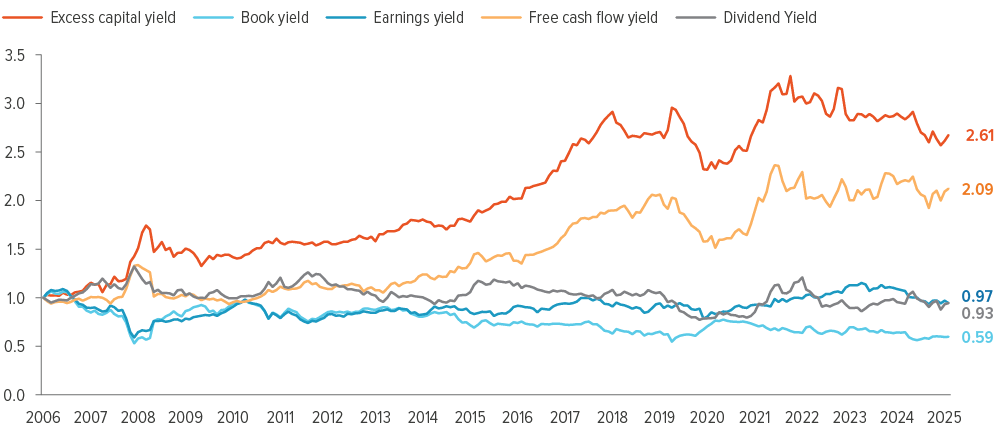
ECY has outperformed traditional valuation metrics over time
Quintile spread returns, R1000V ex-financials, REITS, and utilities
ECY has outperformed traditional valuation metrics over time

As of 12/31/25. Source: FactSet. Returns reflect the spread between the lowest quintile and the highest quintile of the respective factor of the Russell 1000 Value Index (exfinancials, REITs, and utilities) from 01/07 through 12/25. Past performance is no guarantee of future results.

Historically, ECY has differentiated itself from traditional valuation measures by looking beyond price to incorporate a company’s financial flexibility. By accounting for the capital companies have available to deploy, ECY can provide a more complete view of their capacity to enhance shareholder value over time.

IM6100790

Past performance does not guarantee future results. All investing involves risks of fluctuating prices and uncertainties of rates of return and yield. All security transactions involve substantial risk of loss. 

The principal risks are generally those attributable to investing in stocks and related derivative instruments. Holdings are subject to market, issuer, and other risks, and their values may fluctuate. Market risk is the risk that securities or other instruments may decline in value due to factors affecting the securities markets or particular industries. Issuer risk is the risk that the value of a security or instrument may decline for reasons specific to the issuer, such as changes in its financial condition. 

The Voya Large Cap Value strategy employs a quantitative model to execute the strategy. Data imprecision, software or other technology malfunctions, programming inaccuracies, and similar circumstances may impair the performance of these systems, which may negatively affect performance. Furthermore, there can be no assurance that the quantitative models used in managing the strategy will perform as anticipated or enable the strategy to achieve its objective. 

This information is proprietary and cannot be reproduced or distributed. Certain information may be received from sources Voya Investment Management (“Voya IM”) considers reliable; Voya IM does not represent that such information is accurate or complete. Certain statements contained herein may constitute “projections,” “forecasts,” and other “forward-looking statements” which do not reflect actual results and are based primarily upon applying retroactively a hypothetical set of assumptions to certain historical financial data. 

Actual results, performance, or events may differ materially from those in such statements. Any opinions, projections, forecasts, and forward-looking statements presented herein are valid only as of the date of this document and are subject to change. Voya IM assumes no obligation to update any forward-looking information. 

Voya Investment Management has prepared this insight for informational purposes. Nothing contained herein should be construed as (i) an offer to sell or solicitation of an offer to buy any security or (ii) a recommendation as to the advisability of investing in, purchasing, or selling any security. Any opinions expressed herein reflect our judgment and are subject to change. Certain of the statements contained herein are statements of future expectations and other forward-looking statements that are based on management’s current views and assumptions and involve known and unknown risks and uncertainties that could cause actual results, performance, or events to differ materially from those expressed or implied in such statements. Actual results, performance, or events may differ materially from those in such statements due to, without limitation, (1) general economic conditions, (2) performance of financial markets, (3) interest rate levels, (4) increasing levels of loan defaults, (5) changes in laws and regulations, and (6) changes in the policies of governments and/or regulatory authorities. 

The Russell 1000 Value Index measures the performance of those Russell 1000 Index companies with lower price-to-book ratios and lower forecast growth values. Indexes do not reflect fees, brokerage commissions, taxes, or other expenses of investing. Investors cannot invest directly in an index. Past performance does not guarantee future results.

Top