


Private Credit Insights: Juvenile Delinquency

Managing Director, Head of Private Credit

Despite recent bankruptcy headlines causing jitters in private credit markets, most corporate balance sheets remain healthy. But we need to talk about some of this messy lending.
Key takeaways
- Defaults by First Brands, Tricolor, and Renovo seem indicative of some private high yield and broadly syndicated loan managers relaxing lending discipline to win deals in a market where lender supply outweighs borrower demand.
- The good news: Most corporate balance sheets remain healthy, and investment grade private credit underwriting standards—including here at Voya—haven’t budged.
- The bad news: Hidden trouble can lurk in private credit portfolios that regularly compromise on structure and documentation. We show you where to find the skeletons in the closet.
- The bottom line: Private credit returns are increasingly likely to bifurcate between managers with experienced teams who maintain tight covenants and rigorous underwriting, and managers who are compromising on pricing, credit, and/or structure.
Hog wild
A thing I think about a lot these days is the old saw, “Bulls go to the bank, bears go to the bank, and hogs go to slaughter.” We all know in our hearts that 2025 was a toppy year in the markets. It started with managers being pressured to stretch traditional underwriting discipline in the private market, driven by thin corporate bond spreads, copious dry powder, and deal competition from banks. Not every manager acted on it, but the temptation was sure there.
It’s not surprising that this toppiness is now flowing into losses in some portfolios.
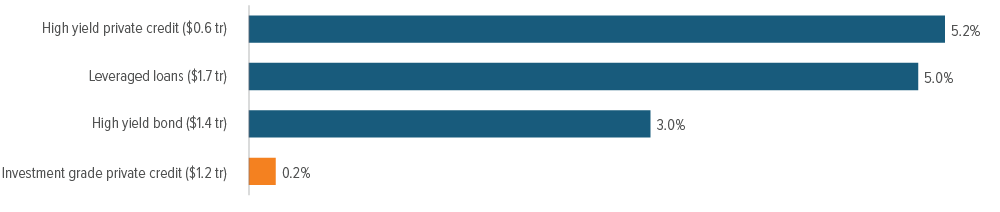
As of 11/21/25. Source: Fitch Ratings, Voya IM estimates. Numbers in parentheses represent estimated total market sizes. Default measurement includes interest deferrals and stressed extensions.
So far, the bankruptcies that have made headlines have involved primarily the leveraged loan and high yield private credit markets, but journalists have labeled it all “private credit.”
What makes it trickier is that some of these loans were included in public CLOs, and Tricolor also had publicly traded subprime auto ABS securitizations. Due to waterfall payment structures, those securitizations all had senior, investment grade tranches—even though none of these borrowers were ever investment grade themselves.
Believe me, I understand why this gets confusing for non-specialists. But even so, there are two important points to keep in mind about private credit right now.
Nobody ever talks about investment grade private credit
The first is that the majority ($1.2 trillion) of private credit is investment grade, and it has a negligible default rate (Exhibit 1).
Investment grade private credit doesn’t make headlines because most journalists don’t even know it exists. That’s because it’s usually held in SMAs on insurance company balance sheets or in comingled trusts for pension funds. This differs significantly from the high yield private credit market, which tends to exist as closed-end direct lending funds or as business development companies (BDCs).
You also don’t hear about investment grade private credit because it doesn’t tend to do newsworthy things. All of it is NAIC rated, and 2/3 of it carries an NRSRO rating at the issuer or placement level. Its underwriting practices tend to be the most rigorous in all of lending.
So if you wouldn’t sell out of investment grade corporate bonds because a junk bond defaulted, don’t avoid investment grade private placements because a couple high yield managers cut corners.
High yield private credit is still mostly fine
Even in the $600 bn high yield private credit market, default rates are not yet at concerning levels. Dig further into October’s default rate of 5.2% and it breaks down into a 10.9% trailing default rate for borrowers with EBITDA under $25 mn and then a much lower default for larger companies (2.9% for borrowers with $25-50 mn EBITDA)1 .
The optimist would take from this that high yield private credit remains quite healthy. The pessimist would say that the big trouble hasn’t hit yet.
The truth, as always, is somewhere in the middle.
A note about risk: All investing involves risks of fluctuating prices and uncertainties of rates of return and yield. All security transactions involve substantial risk of loss.
Private credit: Foreign investing does pose special risks, including currency fluctuation, economic, and political risks not found in investments that are solely domestic. As interest rates rise, bond prices may fall, reducing the value of the share price. Debt securities with longer durations tend to be more sensitive to interest rate changes. High yield securities, or “junk bonds,” are rated lower than investment grade bonds because there is a greater possibility that the issuer may be unable to make interest and principal payments on those securities. Other risks of private credit include, but are not limited to: credit risks, other investment companies risks, price volatility risks, inability to sell securities risks, and securities lending risks.